7 Signs Your Car Battery is 7 Signs Your Car Battery is Dying (And Why Delhi’s Heat Accelerates It)
Your car has been reliable for 3 years. Then one morning, you notice the start is slower than usual. By next week, the lights are dim. By the week after, you’re worried.
Your battery is dying.
The good news? You’ll get warning signs. The bad news? You need to recognize them.
And in Delhi’s brutal heat, the timeline from first warning to complete failure is shorter than you think.
Sign #1: Slow Engine Cranking (The Classic Warning)
This is the first sign you’ll notice.
Instead of your engine starting immediately with a sharp “vroooom,” you hear: “Urrrrr… urrrrr… urrrrr.” Like the engine is struggling to turn on.
What it means:
- Battery losing charge capacity
- Can’t deliver full power to starter motor
- Engine has to work harder to crank
- Electrical system is failing
Timeline:
- First week you notice it: You have 1-4 weeks left
- Get tested immediately
- Don’t ignore this
What to do:
- Bring car to Moscow Batteries
- Get free battery test
- If weak, replace within week
- Don’t wait for complete failure
This is your first warning bell. Don’t miss it.
Sign #2: Dim Headlights (Especially When AC is On)
You’re driving at night. You turn on AC. Your headlights suddenly get noticeably dimmer.
This is bad.
What it means:
- Battery can’t handle multiple loads at once
- AC compressor draws power
- Headlights draw power
- Battery can’t deliver both
Why it happens:
- Weak battery = limited power supply
- AC + headlights = too much demand
- Battery fails to keep up
Timeline:
- If you see this: 2-6 weeks typically before complete failure
- Get battery tested within 2-3 days
- Don’t ignore this
Testing it yourself:
- Park safely
- Turn on headlights (note brightness)
- Turn on AC
- Notice brightness drop? That’s your warning
Sign #3: Dashboard Battery Warning Light (The Red Light)
You see it: A little battery icon on your dashboard. It’s red. It’s lit up.
What it doesn’t mean:
- Not always the battery’s fault (could be alternator)
What it does mean:
- Electrical system is detecting low voltage
- Alternator or battery is failing
- Could be either one
- Need to test both
Why this matters:
- Some cars have smart alternators
- They detect if battery is bad
- Warning light = alert signal
- Don’t panic, but don’t ignore
Timeline:
- Dashboard light = varying urgency
- Could be days or weeks
- Get tested ASAP to know which
What to do:
- Call Moscow Batteries
- “I have battery warning light”
- We test both alternator and battery
- Identify which is the problem
Sign #4: Clicking Sound When Turning Key (Emergency Level)
You turn the key. You hear: “Click… click… click… click” rapid ticking sound.
This is urgent.
What it means:
- Battery has almost no charge left
- Starter motor trying to engage but failing
- Battery might fail completely within 24-48 hours
- Car might not start tomorrow
Why clicking happens:
- Starter needs power to crank engine
- Battery too weak to provide sustained power
- Relay clicks on and off repeatedly
- System giving final warning before complete death
Timeline:
- If you hear this: Next 24-48 hours
- Replace today
- Don’t risk being stranded tomorrow
What to do:
- Don’t try to start again
- Call roadside service immediately
- Have replacement battery brought to you
- Get it replaced before you need to drive
This is not a wait-and-see situation.
Sign #5: Corroded Battery Terminals (The DIY Fix That Often Works)
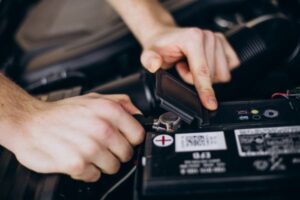
You pop your hood. You look at the battery terminals. You see white, green, or blue crusty buildup around the metal posts.
This is corrosion.
What it means:
- Chemical reaction from battery acid fumes
- Reduces connection quality
- Battery can’t deliver power efficiently
- Often fixable by cleaning
Why Old Delhi sees this more:
- Humidity is high (60-80% in monsoon)
- Narrow lanes trap moisture
- Corrosion happens faster here
- More frequent cleaning needed
Timeline:
- Light corrosion: Can be cleaned, battery OK
- Heavy corrosion: Battery might be failing (replace)
DIY fix that works:
- Turn off engine, disconnect both terminals
- Get wire brush
- Scrub terminals until shiny
- Wipe with clean cloth
- Reconnect
- Try starting
Success rate: 50-70% of the time, car starts better immediately
Cost: Free (if you do it)
Sign #6: Swollen or Bloated Battery Casing (Replace Immediately)
You look at your battery. The plastic case looks puffy. Like it’s expanding.
What this means:
- Internal chemical breakdown
- Pressure building inside
- Risk of leaking or explosion (rare but possible)
- Battery is dying
Danger level: HIGH
Why it happens:
- Overcharging from alternator
- Extreme heat (Delhi summers cause this)
- Internal plate damage
What to do:
- DO NOT TOUCH
- Replace immediately (within 24 hours)
- Don’t delay
- Could be a safety issue
Timeline:
- Swollen battery = emergency
- Replace today, don’t risk it
- Could fail while driving
Sign #7: Battery Leaking or Strange Smell (DANGER)
You smell something rotten. Like rotten eggs. Or you see liquid under the battery.
What this means:
- Battery acid is leaking
- Toxic hydrogen sulfide gas (the smell)
- Hazard to you and your car
- Must be replaced immediately
Danger level: CRITICAL
Why you must act now:
- Acid is corrosive (damages car)
- Fumes are toxic (dangerous to breathe)
- Battery could fail completely
- Could damage alternator or other components
What to do:
- DO NOT TOUCH the liquid
- Call roadside service immediately
- Have battery replaced
- Don’t try to fix this yourself
Timeline:
- Leaking battery = emergency within hours
- Not within days
- Act now
Why Delhi’s Heat Kills Batteries 20% Faster
This is the real insight you need.
In cool climates, batteries last 4.5-5 years. In Delhi, they last 3.5-4 years.
Why?
Temperature acceleration:
- Every 10°C increase = battery ages 2x faster
- Delhi summer = 45-48°C
- Inside car parked in sun = 60°C+
- Battery cell = maximum stress
Chemical reaction:
- Heat speeds up chemical reactions inside
- Lead oxidizes faster
- Electrolyte evaporates
- Capacity degrades quicker
Math:
- Cool city battery = 5 year lifespan
- Delhi battery at 45°C = 3.5 year lifespan
- Difference = 1.5 years shorter life
- Roughly 20-30% reduction
The timeline you should expect:
- Year 1-2: Battery works perfectly
- Year 2.5-3: Start checking regularly
- Year 3: Get tested every month
- Year 3.5: Replace proactively (don’t wait for failure)
- Year 4+: Battery too risky to keep
Quick Checklist (Test These This Week)
 Turn on lights before starting. Are they bright?
 Start engine. Does it crank normally or slowly?
 Turn on AC while driving. Do lights dim?
 Pop hood. Look for corrosion on terminals (white/green powder)?
 Look at battery case. Is it swollen or leaking?
 Check dashboard. Any battery warning lights?
If you answered YES to any of these: Get battery tested this week.
When to Test vs. When to Replace
Test if: You noticed ONE warning sign, could be fixable Replace if: Multiple signs present, or clicking sound, or swollen case, or leaking
Free test: 5 minutes at Moscow Batteries Cost: Nothing if you’re just testing Honesty: We’ll tell you if battery is good for another year or needs replacement now
The Smart Strategy
Don’t wait for emergency. Plan ahead.
- Year 0-2: Enjoy your battery. Nothing needed.
- Year 2-3: Get free checks every 6 months
- Year 3: Monthly checks starting
- Year 3.5: Plan replacement (don’t wait for failure)
Replace proactively before monsoon or summer hits.
You choose the timing. Not your battery.
Free battery test at Moscow Batteries: 8527267799
Call this week. Takes 5 minutes. Tells you everything. No obligation.